Reviewed by Dr. Ronald E. Unterseher, DDS, MS, orthodontist at Orthodontics Inc.
An open bite is the one bite problem people can usually see for themselves: the front teeth do not meet when the back teeth are together, leaving a gap you can pass your tongue through. Braces can fix most open bites, and in children and teenagers the correction is often straightforward. In adults, and in open bites that come from the shape of the jaws rather than the position of the teeth, the plan may involve more than brackets and wires. This guide from Orthodontics Inc., which treats patients across Arizona, Utah, New Mexico and Colorado, explains the types of open bite, what braces for an open bite actually do, and when something else is needed.
Key Takeaways
- An open bite is a gap between the upper and lower front teeth when the back teeth are closed. A less common version leaves the back teeth apart instead.
- Braces correct most dental open bites by moving the front teeth down and, more often, the back teeth up.
- Habits such as thumb sucking and tongue thrusting cause many open bites in children and must be addressed or the bite reopens.
- Skeletal open bites in adults sometimes need braces combined with jaw surgery for a stable result.
- Retention is the critical last stage. Open bites relapse more than most corrections without a well worn retainer.
What an open bite is
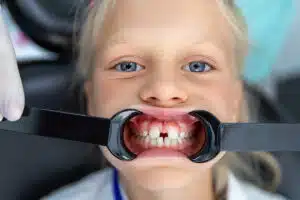
In a normal bite the upper front teeth overlap the lower ones slightly when the molars are together. In an anterior open bite they do not touch at all, and the gap can range from a millimeter to a space wide enough to fit a finger. A posterior open bite, where the back teeth on one or both sides do not meet, is rarer. Open bites make it hard to bite through food with the front teeth, can affect speech, especially s and z sounds, and put extra load on the back teeth that do all the chewing. The Cleveland Clinic covers open bite alongside the other types of malocclusion, and MedlinePlus explains how bite problems are classified.
Why open bites happen
|
Cause |
How it creates the gap |
Who it affects most |
|---|---|---|
|
Thumb or finger sucking past age four or five |
The digit holds the front teeth apart and tips them forward while the back teeth keep erupting |
Young children |
|
Tongue thrust |
The tongue pushes between the front teeth on every swallow, holding them apart |
Children and adults; often persists from childhood |
|
Prolonged pacifier or bottle use |
Same mechanism as thumb sucking |
Toddlers and preschoolers |
|
Mouth breathing and enlarged tonsils or adenoids |
A low tongue posture and open mouth let the back teeth over erupt |
Children |
|
Jaw growth pattern (skeletal open bite) |
The lower jaw rotates down and back as it grows, opening the front |
Teenagers and adults; often runs in families |
|
TMJ changes |
Joint degeneration can rotate the jaw open at the front |
Adults |
|
Tooth loss or wear in back teeth |
Changes in the back of the bite can open the front |
Adults |
A habit driven open bite in a child often closes on its own once the habit stops, provided the permanent teeth have not yet come in. A skeletal open bite does not; it tends to worsen with growth and needs orthodontic treatment, sometimes with surgery.
How braces fix an open bite
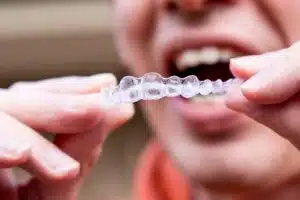
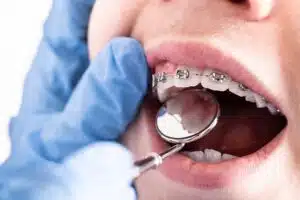
The obvious way to close a gap between the front teeth is to pull the front teeth down, and braces can do that with vertical elastics or by extruding the incisors. The more effective way, and the one that produces more stable results, is to push the back teeth up. Because the lower jaw hinges at the joint, intruding the molars even slightly lets the jaw rotate closed at the front and the incisors meet. Orthodontists do this with braces and a variety of tools: high pull headgear in growing patients, bite blocks, transpalatal arches, and, increasingly, temporary anchorage devices, small titanium screws placed in the gum that give the wire a fixed point to push against. The American Association of Orthodontists explains how braces move teeth in general, and clear aligners are also used for open bites, since a full arch aligner naturally intrudes the back teeth as it is worn; the AAO’s aligner overview covers that.
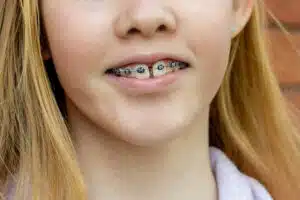
In a child or teenager, treatment often starts with breaking the habit and, where needed, a fixed appliance that reminds the tongue to stay back. Braces then close whatever gap remains. The practice’s Phase 1 versus Phase 2 page describes how early treatment fits with later braces, and the pediatric orthodontist page covers the first assessment.
What treatment looks like from the patient’s side
The first visit is an examination with photographs and X rays, including a side view of the skull that shows whether the open bite is dental or skeletal; that single image decides much of the plan. Braces go on at a second visit. For the first months the wires level and align the teeth as in any case, and the open bite work begins once the arches are ready: elastics worn between the upper and lower front teeth, bite blocks on the molars, or an anchorage device placed at a short visit under local anesthetic. Patients are seen every six to ten weeks. As the front teeth start to touch, usually well before the end of treatment, biting into food becomes easier and the change is obvious in photographs, which is one of the more satisfying corrections to watch.
When braces alone are not enough
An adult with a skeletal open bite has finished growing, and if the gap comes from the shape and rotation of the jaws, moving teeth can close it only so far. Camouflage treatment with braces and anchorage devices closes mild to moderate skeletal open bites well. For a large one, the honest and stable option is braces combined with orthognathic surgery, in which the upper jaw is repositioned so the jaws close properly and the braces finish the alignment. This is planned jointly with an oral surgeon, and Dr. Unterseher says at the consultation whether a case is one braces can handle alone. Attempting to close a large skeletal open bite with teeth alone produces a result that looks closed at the end of treatment and reopens within a few years.
Keeping it closed
Open bites relapse more than most corrections, because the forces that opened the bite, the tongue and the growth pattern, are still there when the braces come off. Retention is therefore built into the plan: a retainer worn as prescribed, usually full time at first and nightly for good, and for tongue thrust patients sometimes a retainer with a tongue crib or a course of exercises to retrain the swallow. The practice’s retainers page explains the options, and the Cleveland Clinic explains why retainers are lifelong.
Orthodontics Inc.
Orthodontics Inc. provides braces and Invisalign for children, teens and adults from offices in St. George and Enterprise, Utah; Flagstaff and Yuma, Arizona; Gallup and Farmington, New Mexico; and Cortez, Colorado. Dr. Ronald E. Unterseher, DDS, MS, has practiced orthodontics for more than thirty years and holds a fellowship with the World Federation of Orthodontists. The meet the doctors page introduces the team; the contact page lists every office and its number.
Frequently asked questions
Can braces fix an open bite?
Yes, for most dental open bites in children, teenagers and adults. Large skeletal open bites in adults may need braces combined with jaw surgery.
How do braces close an open bite?
Mainly by pushing the back teeth up so the jaw rotates closed at the front, and sometimes by bringing the front teeth down with elastics.
How long does it take to fix an open bite with braces?
Typically eighteen to thirty months, depending on the cause and the age of the patient. Habit related open bites in children can close faster.
Can Invisalign fix an open bite?
Often, yes. Aligners cover the back teeth and tend to intrude them slightly, which helps close the front. Dr. Unterseher will say whether your case suits aligners.
Does an open bite fix itself?
In a young child, once thumb sucking or pacifier use stops and before the permanent teeth erupt, sometimes. In teenagers and adults, no.
What is a tongue thrust and does it matter?
A swallowing pattern where the tongue pushes forward between the front teeth. It causes and reopens open bites, so it is treated alongside the braces.
Will an open bite come back after braces?
It can, if retainers are not worn or the tongue habit is not addressed. With good retention the correction is stable.
Can an open bite cause speech problems?
Yes, particularly with s, z and th sounds. Correcting the bite often improves them, sometimes with help from a speech therapist.
Is surgery always needed for an adult open bite?
No. Mild and moderate open bites in adults are treated with braces or aligners, often with anchorage screws. Surgery is reserved for large skeletal cases.
At what age should a child with an open bite see an orthodontist?
By seven, as the AAO recommends, and sooner if a sucking habit continues past age four or five.
—
Think you or your child has an open bite? Book now with Orthodontics Inc. or call the St. George office at (435) 688-7711; the contact page lists all seven other locations.