Reviewed by Dr. Ronald E. Unterseher, DDS, MS, orthodontist at Orthodontics Inc.
Crowding is the most common reason people look into Invisalign, and for most of them the answer is yes: Invisalign for crowded teeth works well when the crowding is mild to moderate and the patient wears the aligners as prescribed. Where it gets more complicated is severe crowding, crowding that comes with a bite problem, and cases where teeth need to be removed to make room. This guide from Orthodontics Inc. explains how aligners make space, where their limits are, and how the orthodontist decides whether your case is an aligner case.
Key Takeaways
- Invisalign treats mild and moderate crowding reliably; severe crowding is possible but less predictable and sometimes better in braces.
- Aligners make room three ways: widening the arch, moving teeth slightly forward, and polishing small amounts of enamel between teeth.
- Rotated canines and premolars are the hardest teeth for aligners to correct; attachments help.
- Wear time decides the result. Twenty to twenty two hours a day, or the plan falls behind.
- A digital scan at the consultation shows exactly how the crowding would be resolved before anything is made.
What crowding is and why it happens
Crowding is a mismatch between the size of the teeth and the space in the jaw for them. When there is not enough room, teeth overlap, rotate, or erupt out of line. It is mostly inherited, a small jaw from one parent and large teeth from the other, and it is often made worse by early loss of baby teeth, which lets neighbors drift into the gap before the adult tooth arrives. Crowded teeth are harder to clean, which raises the risk of decay and gum disease, and they wear unevenly. The Cleveland Clinic covers crowding as one form of malocclusion, and the ADA explains why a healthy bite matters beyond appearance.
How Invisalign makes room
Aligners cannot create bone, so every crowded case is solved by finding space somewhere. There are three sources, and most plans use a combination.
|
Way of making space |
How it works |
When it is used |
|---|---|---|
|
Arch expansion |
The aligners widen the dental arch slightly so the teeth fit around a larger curve |
Mild to moderate crowding, especially narrow arches |
|
Proclination |
Front teeth are tipped slightly forward, lengthening the arch |
Cases where the front teeth are upright or tipped back |
|
Interproximal reduction (IPR) |
A fraction of a millimeter of enamel is polished from between certain teeth |
Mild crowding; avoids extractions in many cases |
|
Molar distalization |
Back teeth are moved backward to make room in front |
Selected cases, often with elastics |
|
Extraction |
One or more teeth removed, usually premolars, and the space closed with aligners |
Severe crowding; more predictable in braces |
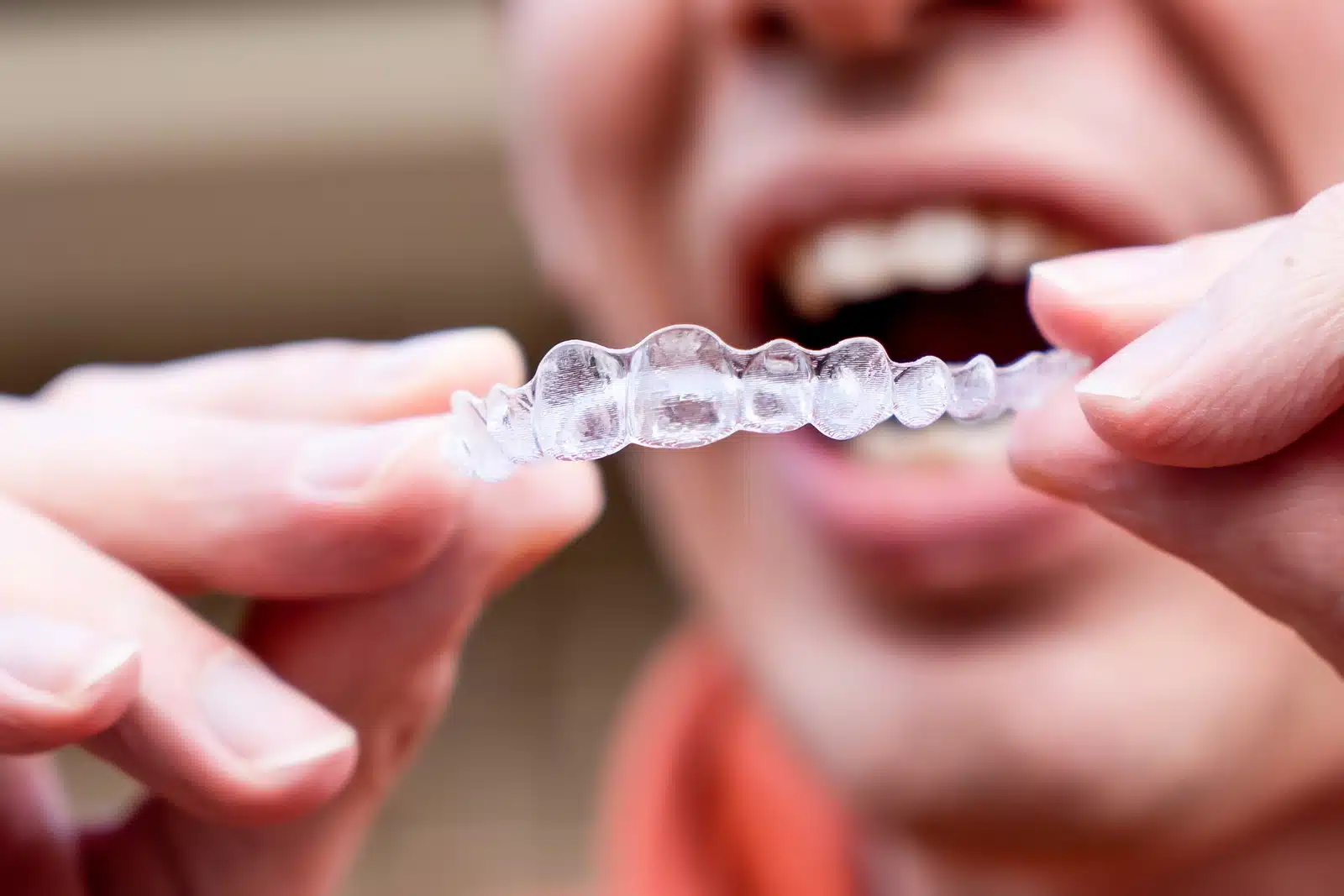
The American Association of Orthodontists describes what aligners can do, and the practice’s Invisalign page covers the service. Once space exists, the aligners rotate and align each tooth in stages, with small tooth colored attachments bonded where a tooth needs extra grip, typically on rotated canines and premolars.
Mild, moderate and severe
Orthodontists classify crowding by how many millimeters of space are missing across the arch. Mild crowding, a few millimeters, is the ideal aligner case; IPR and a little expansion usually resolve it in six to twelve months. Moderate crowding, roughly four to eight millimeters, is still well within Invisalign’s range, though treatment runs longer and attachments and refinements are routine. Severe crowding, beyond that, is where the decision becomes case specific. Aligners can treat it, particularly with extractions, but closing large extraction spaces and controlling the tipping of teeth into them is more predictable with braces, and a well regarded systematic review of aligner effectiveness found exactly that pattern. Dr. Unterseher fits both and recommends by case; the braces page describes the fixed appliance option.
The rotated tooth problem
The single hardest movement for an aligner is rotating a round tooth. Canines and premolars are roughly cylindrical, and a plastic tray pushing on a cylinder tends to slip rather than turn it. This matters for crowding because rotated canines are often exactly what crowding looks like. Modern plans manage it with attachments shaped to give the tray a handle, by staging the rotation slowly, and by planning a refinement series to finish the last few degrees. A patient with a badly rotated canine may be told at the consultation that the case will need refinements, or that a short period of braces on a few teeth would finish it faster.
Crowding with a bite problem
Crowding rarely arrives alone. A crowded arch often comes with a deep bite, a crossbite on one side, or an overjet, and the aligner plan has to correct those at the same time or the straightened teeth will not meet properly. Aligners handle many of these combinations, using bite ramps for deep bites and elastics hooked to small buttons for overjets, but each added problem makes the plan longer and the compliance demand greater. A crowded case with a skeletal crossbite in a teenager may be treated best with an expander first and aligners second; a crowded adult with a severe deep bite may finish more predictably in braces. This is why the consultation looks at the whole bite rather than the visible crowding, and why two patients with similar looking front teeth can receive different recommendations.
Compliance, and why it decides everything
An aligner only moves teeth while it is in the mouth. Invisalign is designed for twenty to twenty two hours of wear a day, changed every one to two weeks. A patient who wears trays sixteen hours a day is not getting most of the result; teeth that are not held drift back between wears, the next tray stops fitting, and the plan falls behind. For teenagers, Invisalign Teen includes wear indicators that fade with use, so both parents and the orthodontist can see whether the hours are being put in. The practice’s orthodontist for teens page covers teen treatment, and the earlier post on whether Invisalign works is candid about who does well with it.
What the consultation shows
The question of whether Invisalign can fix your crowding is answered with a scan rather than a guess. A digital scan of both arches is turned into a simulation that shows the teeth moving stage by stage to the planned result, with the amount of IPR, expansion and any extractions specified. Patients see the projected end result before committing, and the orthodontist can say at the same visit how many aligners the plan needs, how long it will take, and whether braces would be the more predictable route. Retention follows every case; the retainers page explains why teeth that were crowded once will crowd again without one, and the Cleveland Clinic explains retainer care.
Orthodontics Inc.
Orthodontics Inc. provides Invisalign and braces for children, teens and adults from offices in St. George and Enterprise, Utah; Flagstaff and Yuma, Arizona; Gallup and Farmington, New Mexico; and Cortez, Colorado. Dr. Ronald E. Unterseher, DDS, MS, is Invisalign certified and has practiced orthodontics for more than thirty years. See meet the doctors and the contact page for every office.
Frequently asked questions
Can Invisalign fix crowded teeth?
Yes, for mild and moderate crowding, and often for severe crowding with extractions, though the latter is sometimes more predictable in braces.
How does Invisalign make space for crowded teeth?
By widening the arch slightly, tipping front teeth forward, polishing small amounts of enamel between teeth, moving molars back, or, in severe cases, closing the space left by extractions.
Is interproximal reduction safe?
Yes. It removes a fraction of a millimeter of enamel from between teeth, less than normal wear over a lifetime, and the surfaces are polished smooth.
How long does Invisalign take for crowded teeth?
Six to twelve months for mild crowding, twelve to eighteen for moderate, and eighteen months or longer for severe cases.
Can Invisalign fix severely crowded teeth?
Sometimes, usually with extractions. Braces are often recommended for severe crowding because they close extraction spaces more predictably.
Can Invisalign rotate a crowded canine?
Yes, with attachments and careful staging, though rotations of rounded teeth are the movement most likely to need a refinement series.
Do I need teeth pulled for Invisalign?
Most crowded cases do not. Extractions are reserved for severe crowding where expansion and IPR cannot create enough space.
Will crowding come back after Invisalign?
It can, if a retainer is not worn. Lower front teeth in particular drift for life, so a nightly retainer is permanent.
Is Invisalign or braces better for crowding?
For mild and moderate crowding, either works and the choice is the patient’s. For severe crowding or crowding with a complex bite, braces are more predictable.
Can teenagers get Invisalign for crowding?
Yes. Invisalign Teen is designed for it, with wear indicators and replacement aligners, provided the teenager will wear the trays as prescribed.
—
Crowded teeth? Find out whether Invisalign is the right fix at a consultation with Orthodontics Inc. Book now or call the St. George office at (435) 688-7711; the contact page lists all seven other locations.